
The Washington State Department of Health (DOH) is working with local health jurisdictions to respond to a multi-county outbreak of E. coli O157:H7 that may be linked to fresh produce.
The outbreak currently includes six confirmed cases across Benton County (1), King County (3), Snohomish County (1) and Walla Walla County (1). DOH is only reporting confirmed cases infected with bacteria that have been genetically linked, but local health officials may report higher numbers for their counties that include cases still under investigation.
There is one case in the outbreak between ages 0-9, two cases age 10-19, one case age 20-29, one age 30-39, and one case age 70-79. Three cases have been hospitalized and one case developed hemolytic uremic syndrome (HUS). HUS is a serious complication of E. coli O157:H7 infection that can damage the kidneys and other organs. The earliest case in the outbreak started having symptoms March 9, and the most recent case had symptoms starting April 21.
The Snohomish Health District announced Tuesday evening that it has identified two cases of Shiga toxin-producing E. coli (STEC) in Snohomish County residents. Following public health interviews, these cases do appear to be connected to a cluster of STEC cases among seven children in King County.
The local cases involve a woman in her 20s and a child under 10 years of age from separate households. The child has been hospitalized, but no further information will be shared on the cases due to patient privacy.
Seattle King County Public Health is investigating a cluster of seven children infected with Shiga toxin-producing E. coli (also known as STEC) in King County. All cases are currently under 15 years of age, and three are under 5 years of age. Cases have been reported during April 22–May 1, 2021.
All 7 children developed symptoms consistent with STEC, including diarrhea (often bloody), abdominal cramping, nausea, and vomiting. Illness onsets occurred during April 17–29, 2021. Six children have been hospitalized; this includes two children who developed a type of kidney complication called hemolytic uremic syndrome (HUS) and both are recovering.
From PCC:

 The Snohomish Health District said Tuesday it has identified two cases of Shiga toxin-producing E. coli (STEC) in Snohomish County residents. Following public health interviews, these cases do appear to be connected to
  JBS USA Food Company, a Greeley, Colo. firm and Importer of Record, is recalling approximately 4,860 pounds of imported boneless beef products that may be contaminated with E. coli O157:H7, the U.S. Department of Agriculture’s Food Safety and Inspection Service (FSIS) announced today.
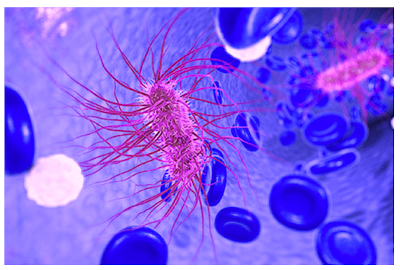 As the most notorious Shiga toxin-producing E. coli (STEC) serotype in the United States, E. coli O157:H7 is a common cause of bloody diarrhea and the most common cause of hemolytic uremic syndrome (HUS), a severe complication that involves kidney failure and is fatal in approximately 5-6% of cases. E. coli O157:H7 causes an estimated 63,153 illnesses, 2,138 hospitalizations, and 20 deaths in the United States each year due to foodborne transmission alone.
 5 states, 16 sick with 1 death. Whole genome sequencing (WGS) shows cases are likely related to same food. Previous outbreak with same WGS linked to romaine lettuce, ground beef, and recreational water.
 E. coli – Unknown
 E. coli – Leafy Greens
 E. coli – Leafy Greens

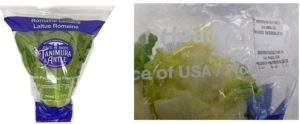
 Tanimura & Antle Inc. is voluntarily recalling its packaged single head romaine lettuce under the Tanimura & Antle brand, labeled with a packed on date of 10/15/2020 or 10/16/2020, due to possible contamination with E. Coli 0157:H7. Packages contain a single head of romaine lettuce with the UPC number 0-27918-20314-9. No other products or pack dates are being recalled. There have been no reported illnesses associated with the recalled product.