Mystery E. coli Outbreak 1 – possibly linked to 2018 Yuma Romaine E. coli Outbreak.

As of October 28, 2020, a total of 21 people infected with the outbreak strain of E. coli O157:H7 have been reported from eight states.

Illnesses started on dates ranging from June 6, 2020, to October 5, 2020. Ill people range in age from  2 to 75 years, with a median age of 24 years. Sixty-seven percent of ill people are female. Of 16 ill people with information available, 8 hospitalizations have been reported, including 1 person who developed hemolytic uremic syndrome (HUS), a type of kidney failure. One death has been reported from Michigan.

Several ill people have been identified as part of an illness cluster at a restaurant. An illness cluster is defined as two or more people from different households who report eating at the same restaurant location, attending a common event, or purchasing food at the same grocery store in the week before becoming ill. Investigating illness clusters can provide critical clues about the source of an outbreak. If several unrelated ill people ate or shopped at the same location of a restaurant or store within several days of each other, it suggests that the contaminated food item was served or sold there.

The strain of E. coli O157:H7 causing illness in this outbreak has previously caused outbreaks linked to different sources, including an outbreak linked to romaine lettuce in 2018. However, food linked to a previous outbreak alone is not enough to prove a link in another outbreak of the same strain. This is because different foods can be contaminated by the same strain of bacteria.

Mystery E. coli Outbreak 2 – possibly linked to 2019 Salinas Romaine E. coli Outbreak.

As of October 28, 2020, a total of 23 people infected with the outbreak strain of E. coli O157:H7 have been reported from 12 states.
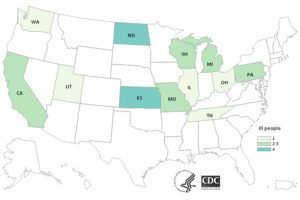
Illnesses started on dates ranging from August 17, 2020, to October 8, 2020. Ill people range in age from 5 to 81 years, with a median age of 21 years. Sixty-seven percent of ill people are female. Of 15 ill people with information available, 10 hospitalizations have been reported, including 2 people who developed hemolytic uremic syndrome (HUS), a type of kidney failure. No deaths have been reported.

State and local public health officials are interviewing ill people to determine what they ate and other exposures in the week before they got sick. People have reported eating a variety of foods, including leafy greens. Of the 13 people interviewed to date, all reported eating various types of leafy greens, like iceberg lettuce (9), romaine lettuce (8), mixed bag lettuce (6), and spinach (9).

This outbreak is caused by the same strain of E. coli O157:H7 that caused an outbreak linked to romaine lettuce in 2019. However, food linked to a previous outbreak alone is not enough to prove a link in another outbreak of the same strain. This is because different foods can be contaminated by the same strain of bacteria.

In the beginning of yet another – in fact two E. coli Outbreaks that have sickened dozens, Marler Clark, The Nation’s Food Safety Law Firm, relaunches www.about-ecoli.com.

E. coli: Marler Clark, The Food Safety Law Firm, is the nation’s leading law firm representing victims of E. coli outbreaks and hemolytic uremic syndrome (HUS). The E. coli lawyers of Marler Clark have represented thousands of victims of E. coli and other foodborne illness infections and have recovered over $700 million for clients. Marler Clark is the only law firm in the nation with a practice focused exclusively on foodborne illness litigation. Our E. coli lawyers have litigated E. coli and HUS cases stemming from outbreaks traced to ground beef, raw milk, lettuce, spinach, sprouts, and other food products.  The law firm has brought E. coli lawsuits against such companies as Jack in the Box, Dole, ConAgra, Cargill, and Jimmy John’s.  We have proudly represented such victims as Brianne Kiner, Stephanie Smith and Linda Rivera.

If you or a family member became ill with an E. coli infection or HUS after consuming food and you’re interested in pursuing a legal claim, contact the Marler Clark E. coli attorneys for a free case evaluation.

Additional Resources

The U.S. Department of Agriculture’s Food Safety and Inspection Service (FSIS) is issuing a public health alert because approximately 70 pounds of raw beef ravioli products, produced by P&S Ravioli Company, a Philadelphia, Pa. establishment, may be contaminated with E. coli O157:H7. A recall was not requested because the affected product is no longer available for purchase.

However, FSIS is concerned that some product may be in consumers’ freezers. Consumers who have purchased these products should not consume them. These products should be thrown away or returned to the place of purchase.

The frozen, raw ground beef ravioli items were produced on April 30, 2020. The following product is subject to the public health alert: [View Label (PDF only)]

13-oz. boxes containing “P&S RAVOLI COMPANY 12 JUMBO MEAT RAVIOLI” with a use-by date of 11/30/2020 and lot code 20121.
The products bear establishment number “EST. 2736” inside the USDA mark of inspection. These items were shipped to a limited number of retail locations in New Jersey and Pennsylvania.

The problem was discovered when P&S Ravioli Company was notified by their third-party laboratory that a sample was positive for E. coli O157:H7, but the products associated with the sample had already been shipped into commerce. The establishment notified FSIS of the sampling results and subsequently controlled all product remaining for sale.

There have been no confirmed reports of adverse reactions due to consumption of these products. Anyone concerned about an injury or illness should contact a healthcare provider.

E. coli O157:H7 is a potentially deadly bacterium that can cause dehydration, bloody diarrhea and abdominal cramps 2–8 days (3–4 days, on average) after exposure the organism. While most people recover within a week, some develop a type of kidney failure called hemolytic uremic syndrome (HUS). This condition can occur among persons of any age but is most common in children under 5-years old and older adults. It is marked by easy bruising, pallor, and decreased urine output. Persons who experience these symptoms should seek emergency medical care immediately.

Up from last months count of 39 , the CDC announced today that a total of 51 people infected with the outbreak strain of E. coli O103 were reported from 10 states – Idaho, Utah, Wyoming, Texas, Iowa, Missouri, Illinois, Florida, Virginia and New York.
Illnesses started on dates ranging from January 6, 2020, to March 15, 2020. Ill people ranged in age from 1 to 79 years, with a median age of 29 years. Fifty-five percent of ill people were female. Of 41 ill people with information available, 3 were hospitalized and no deaths were reported.

Epidemiologic, traceback, and laboratory evidence indicated that clover sprouts were the source of this outbreak.

Seventeen (63%) of 27 people interviewed reported eating sprouts at a Jimmy John’s restaurant. Jimmy John’s LLC reported that all of their restaurants stopped serving clover sprouts on February 24, 2020. Clover sprouts are no longer available at Jimmy John’s restaurants.

Additionally, FDA identified the outbreak strain of E. coli O103 in samples of Chicago Indoor Garden products that contain sprouts. On March 16, 2020, Chicago Indoor Garden recalled all products containing red clover sprouts.

FDA’s traceback investigationexternal icon showed that a common seed lot was used to grow both the sprouts recalled by Chicago Indoor Garden and sprouts that were served at some Jimmy John’s locations. The same seed lot was also used to grow sprouts linked to an outbreak of the same strain of E. coli O103 infections in 2019.

As of March 17, 2020, 39 people infected with the outbreak strain of E. coli O103 have been reported from six states – Florida (1), Illinois (6), Iowa (3), Missouri (1), Texas (1) andUtah (27).

Illnesses started on dates ranging from January 6, 2020, to March 2, 2020. Ill people range in age from 1 to 79 years, with a median age of 28. Fifty-three percent of ill people are female. Two people have been hospitalized. No deaths have been reported.

Epidemiologic, traceback, and laboratory evidence indicate that clover sprouts are the source of this outbreak.

State and local public health officials are interviewing ill people to determine what they ate and other exposures they had in the week before their illness started. Sixteen (59%) of 27 people interviewed reported eating sprouts. This percentage is significantly higher than results from a survey of healthy people in which 8% reported eating sprouts in the week before they were interviewed. Fourteen (58%) of 24 people interviewed reported eating sprouts at a Jimmy John’s restaurant.

Jimmy John’s LLC reported that all of their restaurants stopped serving clover sprouts on February 24, 2020. Clover sprouts should no longer be available at Jimmy John’s restaurants.

FDA identified the outbreak strain of E. coli O103 in samples of Chicago Indoor Garden products that contain sprouts. On March 16, 2020, Chicago Indoor Garden recalled all products containing red clover sprouts.

FDA’s traceback investigation has shown that a common seed lot was used to grow the sprouts recalled by Chicago Indoor Garden and the sprouts that were served at Jimmy John’s locations where people sickened in the current outbreak reported eating. The same seed lot was also used to grow sprouts linked to an outbreak of the same strain of E. coli O103 infections in 2019.

Florida Department of Health was notified of at least three E. coli O157 cases in January 2019 who dined at Bern’s Steak House, located in Tampa, Florida. In food history interviews, these cases reported dining at Bern’s between January 2 – January 7. For these three cases, illness onset occurred between January 8 – January 11.

At least two of these cases made a foodborne illness complaint against Bern’s at their local health department. It is not clear if any investigation was conducted at the restaurant by the Florida Department of Health in response to these complaints. However, online information regarding inspection history of Tampa, Florida restaurants suggests that an investigation was conducted at Bern’s on January 16, at which point 11 violations were noted.

The inspector observed several notable violations including ready-to-eat, potentially hazardous, foods requiring time and/or temperature control being inadequately held for more than 24 hours as well as multiple instances of employees handling ready-to-eat food with bare hands without any subsequent “kill” step. Further, handwash sinks were improperly stocked, and the required handwashing signs were absent from employee handwash sinks. Other citations included issues with storage of personal belongings, container and kitchen tool defects, unmarked and undated foods. A follow-up visit on January 22 found these issues to be corrected, yet an observation regarding use of cutting boards that were in an uncleanable state was noted and subsequently found to be unremedied a week later.

Additional inspection records leading up to the January inspections demonstrate a history of similar health code violations. Specifically, inadequately stocked employee handwash facilities were a chronic violation and observations of improperly maintained food handling equipment were regularly cited.

As of February 25, 2020, 14 people infected with the outbreak strain of E. coli O103 have been reported from five states.
Illnesses started on dates ranging from January 6, 2020, to February 11, 2020. Ill people range in age from 1 to 79 years, with a median age of 28. Sixty-two percent of ill people are male. No hospitalizations and no deaths have been reported.

Illnesses might not yet be reported due to the time it takes between when a person becomes ill and when the illness is reported. This takes an average of 3 to 4 weeks. Please see the Timeline for Reporting Cases of E. coli Infection for more details.

Epidemiologic evidence indicates that sprouts from Jimmy John’s restaurants are a likely source of this outbreak.

State and local public health officials are interviewing ill people to determine what they ate and other exposures in the week before their illness started. Five of six people (83%) interviewed reported eating at a Jimmy John’s restaurant. Of the six people interviewed, four (67%) remembered eating sprouts on a sandwich from Jimmy John’s.

Jimmy John’s LLC reported that all of its restaurants stopped serving clover sprouts on February 24, 2020. Investigators are working to trace the source of the clover sprouts served at the Jimmy John’s restaurants where sick people ate, and to determine whether other restaurants or retailers received the same clover sprouts.

On October 1, 2019, Salt Lake County Health Department launched an investigation into Spitz restaurant, including the location at 3158 E 6200 Street in Holladay, Utah, after two cases with confirmed and matching Shiga toxin-producing E. coli O157 infections were reported to have eaten there. Both confirmed cases were male and between 20-49 years of age.

The health department also identified another ill case who had consumed food from a Spitz location in Utah County. A total of four laboratory confirmed cases were considered part of this outbreak. Exposure to two different Spitz locations occurred on September 9 – September 12, 2019. Cases fell ill with nausea, vomiting, abdominal cramping, and bloody diarrhea between September 11 and September 17, and two cases were hospitalized. This cluster was assigned the CDC cluster code 1909UTEXH-1.

Inspection of the restaurant confirmed that the location had issues with proper holding temperatures for meat on the spit and issues with proper procedures for raw and ready-to-eat meats. The location staff were also noted to lack food safety knowledge.

Quesos La Ricura LTD. of Hicksville, NY, is recalling 12 oz. packages of Cotija Cheese (Queso Cotija) because it may be contaminated with Shiga toxin producing E. coli bacteria (Shiga toxin producing E. coli). Shiga toxin producing E. coli causes a diarrheal illness often with bloody stools. Although most healthy adults can recover completely within a week, some people can develop a form of kidney failure called Hemolytic Uremic Syndrome (HUS). HUS is most likely to occur in young children and the elderly. The condition can lead to serious kidney damage and even death.

Cotija Cheese (Queso Cotija) was distributed through retail stores in NY, NC, PA, GA, FL

This product comes in a plastic wrapped yellow styrofoam container with a label reading “Quesos La Ricura Queso Cotija, Cotija Cheese aged over 60 days” UPC: 7 69087 00933 6 and a weight of 12 oz. This information only applies to “Sell By” date May 20, 2020-3/ May 20, 2020-4.

No illnesses have been reported to date.

A voluntary recall has initiated after sampling at retail by the Florida Department of Agriculture and Consumer Services discovered that the product was contaminated with Shiga toxin producing E. coli.

Sprouts Unlimited of Marion IA is recalling clover spouts in 4 oz packages because it may be contaminated with Escherichia coli O103 bacteria (E. coli O103). E. coli O103 causes a diarrheal illness often with bloody stools. Although most healthy adults can recover completely within a week, some people can develop a form of kidney failure called Hemolytic Uremic Syndrome (HUS). HUS is most likely to occur in young children and the elderly. The condition can lead to serious kidney damage and even death.

The affected batches of clover sprouts were distributed to Hy Vee Food stores, Fareway Food Stores and Jimmy John’s restaurants in Iowa.

The sprouts available at retail were packaged in in pint containers from Sprouts Unlimited Inc. with a blue label on the lid. The UPC code 7 32684 00013 6 is stamped on the bottom right side of the label.

Sprouts Unlimited Inc. became aware of the potential contamination after receiving information from the Iowa Department of Inspections and Appeals, Des Moines, IA that a cluster of E. coli O103 illnesses epidemiologically linked to clover sprouts from Sprouts Unlimited Inc. An investigation and further tests are being conducted to determine the source.

Come on Jimmy (and Hy Vee and Fareway).

  • Multistate Salmonella Outbreak, Jimmy John’s Restaurants Sprouts 2018

As of January 18, 2018, eight people infected with the outbreak strain of Salmonella Montevideo have been reported from Illinois, Wisconsin and Minnesota. Illnesses started on dates ranging from December 20, 2017 to January 3, 2018. Ill people range in age from 26 to 50, with a median age of 34. All 8 (100%) are female. No hospitalizations and no deaths have been reported.  Evidence indicates that raw sprouts served at Jimmy John’s restaurants are a likely source of this multistate outbreak.

Federal, state, and local health and regulatory officials are conducting traceback investigations from the six Jimmy John’s locations where ill people ate raw sprouts. These investigations are ongoing to determine where the sprouts were distributed, and to learn more about the potential route of contamination. 

  • Multistate E. coli O121 Outbreak, Jimmy John’s Restaurants Alfalfa Sprouts 2014

19 Sickened – Public health officials in California, Idaho, Michigan, Montana, Utah and Washington collaborated with their federal partners at the Centers for Disease Control and Prevention (CDC) and the Food and Drug Administration (FDA) to investigate an outbreak of E. coli O121 that occurred in May 2014.  A total of 19 persons with the outbreak strain, identified by PulseNet PFGE Pattern Identification Numbers EXKX01.0011/EXKA26.0001, were reported.  Among persons for whom information was available, dates of illness onset ranged from May 1, 2014 to May 20, 2014.  Ill persons ranged from 11 years to 52 years.  Seven of 16 persons for whom information was available were hospitalized.  No ill person developed hemolytic uremic syndrome and no deaths were reported.

Epidemiologic and traceback investigations conducted by public health officials implicated raw clover sprouts produced by Evergreen Fresh Sprouts, LLC of Hayden, Idaho as the likely source of this outbreak.  Thirteen (81%) of 16 ill persons reported eating raw clover sprouts in the week before becoming ill.  Ill persons in Washington and Idaho reported eating sprouts in sandwiches at several local food establishments including several Jimmy John’s Gourmet Sandwiches locations, the Pita Pit, and Daanen’s Deli.

As part of the investigation the FDA performed a traceback analysis and determined that Evergreen Fresh Sprouts supplied sprouts to seven restaurants with outbreak associated cases.  This analysis used documents collected directly from the distributors and the grower, Evergreen Fresh Sprouts, as well as documents collected by the states from the points of service.

The FDA conducted several inspections at the Evergreen Fresh Sprouts facility in May and June.  During the inspections FDA investigators observed a number of unsanitary conditions, including condensate and irrigation water dripping from rusty valves, a rusty and corroded watering system in the mung bean room, tennis rackets (used to scoop mung bean sprouts) that had scratches, chips and frayed plastic; a pitchfork (used to transfer mung bean sprouts) that had corroded metal, and a squeegee (used to agitate mung bean sprouts inside a soak vat) that had visible corroded metal and non-treated wood.

On June 26, 2014 the FDA and CDC held a meeting with the owner of Evergreen Fresh Sprouts to advise the firm of FDA’s concerns that the seed lot used to row clover sprouts linked to this outbreak might be contaminated and to encourage Evergreen Fresh Sprouts to discontinue using that seed lot.  The owner of Evergreen Fresh Sprouts agreed to stop using the suspected lot of seeds.

  • Multistate E. coli O26 Outbreak, Jimmy John’s Restaurants Alfalfa Sprouts 2012

29 Sickened – A total of 29 individuals infected with the outbreak strain of E. coli O26 were reported from 11 states, including:  Alabama (1), Arkansas (1), Iowa (5), Kansas (2), Michigan (10), Missouri (3), Ohio (3), Pennsylvania (1), Washington (1), Wisconsin (1), and West Virginia (1).

Of the 27 ill persons with available information, 23 (85%) reported consuming sprouts at Jimmy John’s restaurants in the 7 days preceding illness.  Among 29 ill persons, illness onset dates ranged from December 25, 2011 to March 3, 2012.  Ill persons range in age from 9 years to 57 years old, with a median age of 26 years.  89% of ill persons are female.  Among the 29 ill persons, 7 (24%) were hospitalized. None developed HUS, and no deaths were reported.

Preliminary traceback information identified a common lot of clover seeds used to grow clover sprouts served at Jimmy John’s restaurant locations where ill persons ate.  FDA and states conducted a traceback that identified two separate sprouting facilities; both used the same lot of seed to grow clover sprouts served at these Jimmy John’s restaurant locations.  On February 10, 2012, the seed supplier-initiated notification of sprouting facilities that received this lot of clover seed to stop using it.

Results of the epidemiologic and traceback investigations indicated eating raw clover sprouts at Jimmy John’s restaurants was the likely cause of this outbreak.

  • Sprouters Northwest, Jimmy John’s Restaurants Clover Salmonella Sprouts Outbreak 2010

7 Sickened – Sprouters Northwest of Kent, Washington, issued a product recall after the company’s clover sprouts had been implicated in an outbreak of Salmonella Newport in Oregon and Washington. At least some of the cases had consumed clover sprouts while at a Jimmy John’s restaurant. Jimmy John’s Restaurants are a restaurant chain that sells sandwiches. Concurrent with this outbreak, a separate Salmonella outbreak (Salmonella, serotype I 4,5,12,i- ; see Multistate Outbreak, Tiny Greens Organic Farm, Jimmy John’s Restaurants), involving alfalfa sprouts served at Jimmy John’s restaurants was under investigation. The recall of Northwest Sprouters products included: clover; clover & onion; spicy sprouts; and deli sprouts. The Sprouters Northwest products had been sold to grocery stores and wholesale operations in Washington, Oregon, Idaho, Alaska, British Columbia, Saskatchewan, and Alberta. The FDA inspection found serious sanitary violations.

  • Multistate Salmonella Outbreak, Tiny Greens Organic Farm, Jimmy John’s Restaurants Alfalfa Sprouts 2010

140 Sickened – On December 17, the Illinois Department of Health announced that an investigation was underway into an outbreak of Salmonella, serotype I4,[5],12:i:-. Many of the Illinois cases had eaten alfalfa sprouts at various Jimmy John’s restaurants in the Illinois counties of: Adams, Champaign, Cook, DuPage, Kankakee, Macon, McHenry, McLean, Peoria, and Will counties. The sprouts were suspected to be the cause of the illnesses. On December 21, Jimmy John Liautaud, the owner of the franchised restaurant chain, requested that all franchisees remove sprouts from the menu as a “precautionary” measure. On December 23, the Centers for Disease Control revealed that outbreak cases had been detected in other states and that the outbreak was linked with eating alfalfa sprouts while at a nationwide sandwich chain. On December 26, preliminary results of the investigation indicated a link to eating Tiny Greens’ Alfalfa Sprouts at Jimmy John’s restaurant outlets. The FDA subsequently advised consumers and restaurants to avoid Tiny Greens Brand Alfalfa Sprouts and Spicy Sprouts produced by Tiny Greens Organic Farm of Urbana, Illinois. The Spicy Sprouts contained alfalfa, radish and clover sprouts. On January 14, 2011, it was revealed that the FDA had isolated Salmonella serotype I4,[5],12:i:- from a water runoff sample collected from Tiny Greens Organic Farm; the Salmonella isolated was indistinguishable from the outbreak strain. The several FDA inspections of the sprout growing facility revealed factors that likely led to contamination of the sprouts.

  • CW Sprouts, Inc., SunSprout Sprouts, “restaurant chain (Chain A),” a.k.a. Jimmy John’s Salmonella Outbreak 2009

256 Sickened – In February, Nebraska Department of Health and Human Services officials identified six isolates of Salmonella Saintpaul. Although this is a common strain of Salmonella, during 2008, only three cases had been detected in Nebraska and only four subtypes of this outbreak strain had been identified in 2008 in the entire USA. As additional reports were made, a case control study was conducted; alfalfa sprout consumption was found to be significantly related to illness. The initial tracebacks of the sprouts indicated that although the sprouts had been distributed by various companies, the sprouts from the first cases originated from the same sprouting facility in Omaha, Nebraska. Forty-two of the illnesses beginning on March 15 were attributed to sprout growing facilities in other states; these facilities had obtained seed from the same seed producer, Caudill Seed Company of Kentucky. The implicated seeds had been sold in many states. On April 26, the FDA and CDC recommended that consumers not eat raw alfalfa sprouts, including sprout blends containing alfalfa sprouts. In May, FDA alerted sprout growers and retailers that a seed supplier, Caudill Seed Company of Kentucky, was withdrawing all alfalfa seeds with a specific three-digit prefix.  Many of the illnesses occurred at “restaurant chain (Chain A).”

  • Jimmy John’s Restaurant Alfalfa Sprouts and Iceberg Lettuce E. coli Outbreak 2008

28 Sickened – Several University of Colorado students from one sorority became ill with symptoms of bloody diarrhea and cramping. Additional illnesses were reported. E. coli O157:NM(H-) was determined to be the cause. Consumption of alfalfa sprouts at the Jimmy John’s Restaurants in Boulder County and Adams County were risk factors for illness. In addition, the environmental investigation identified Boulder Jimmy John’s food handlers who were infected with E. coli and who had worked while ill. The health department investigation found a number of critical food handling violations, including inadequate handwashing. The fourteen isolates from confirmed cases were a genetic match to one another.