

Seventeen people in Florida and Georgia have been confirmed infected with the outbreak strain of E. coli O145:H28 linked to frozen organic blueberries from Frutas y Hortalizas del Sur S.A. of San Carlos, Chile. Six have been hospitalized. No deaths have been reported. Illnesses began between May 11 and August 2, 2026, and the recall has now expanded three times — most recently on September 2, when a lot of Great Value Organic Triple Berry Blend sold at Walmart stores in sixteen states was pulled. FDA’s investigation is open.
What has been recalled
- July 3, 2026 — Frutas y Hortalizas del Sur recalled one lot of frozen GreenWise Organic IQF Blueberries, 10 oz, lot code 60401 (printed 6 040 01), Best By February 9, 2028, sold at Publix.
- July 29, 2026 — Publix recalled all lots of GreenWise Organic Whole Blueberries and Whole Mixed Berries, in both 10-ounce and 48-ounce bags.
- September 2, 2026 — the company expanded the recall to Great Value Organic Triple Berry Blend, 10 oz, lot code 6040 01-6, Best By February 9, 2028, sold at Walmart.
Where the berries went, and where people got sick
Recalled product is confirmed to have been distributed in nineteen states: Alabama, Arkansas, Florida, Georgia, Illinois, Indiana, Kentucky, Louisiana, Minnesota, Mississippi, Missouri, North Carolina, Ohio, Oklahoma, South Carolina, Tennessee, Texas, Virginia and Wisconsin. FDA cautions that the product could have traveled further. Confirmed illnesses, so far, are only in Florida (13) and Georgia (4) — which reflects where the first cluster was found and interviewed, not necessarily where the berries were eaten.
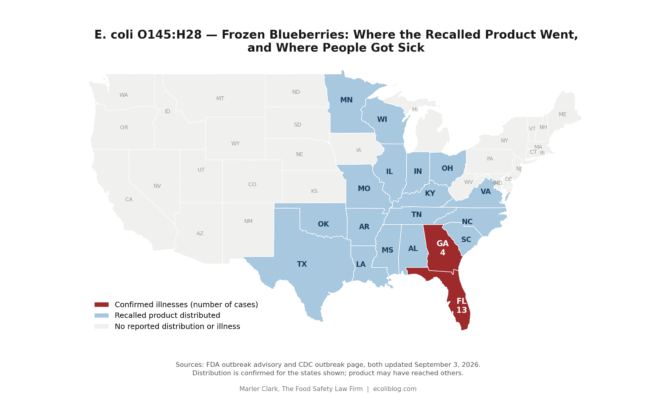
Product distribution and reported illnesses in the 2026 frozen blueberry E. coli O145:H28 outbreak. Sources: FDA and CDC, September 3, 2026.
Two numbers are worth watching. CDC says the true case count is almost certainly higher than what has been reported, because most people with E. coli recover without ever being tested. And FDA’s own advisory is internally inconsistent on the last illness onset — the narrative says August 2, the case-count box says August 6. It is a small thing, but in an outbreak the last onset date is how everyone judges whether the contaminated product is still out there.
Freezing does not kill E. coli
The Best By date on these bags is February 9, 2028. That is the whole problem with a frozen product. Freezing does not kill Shiga toxin-producing E. coli; it preserves it. A bag bought in May can still make someone sick in November, and berries get eaten raw — in smoothies, in yogurt, straight out of the bag by a child standing at the freezer door. There is no cook step to save anyone. Check your freezer, and if you repackaged berries and cannot tell what they were, throw them out.
What FDA has done
FDA conducted a remote regulatory assessment of the Chilean firm and pulled its records. Based on what inspectors found, the agency had concerns about at least one additional lot of blueberries used in other GreenWise products — which is what drove Publix’s all-lots recall in July. FDA also says it has concerns about other products from this firm that have not yet entered the U.S. market, and it has placed the company on Import Alert 99-35, meaning its frozen blueberries can be detained at the border without physical examination.
What we still do not know
The source of the contamination has not been identified — not the water, not the field, not the packing line. No product-positive test result has been announced publicly; the link so far rests on epidemiology, with 11 of 13 interviewed patients reporting frozen blueberries. FDA and CDC have not said whether any of the six hospitalized patients developed hemolytic uremic syndrome. And the fact that a Walmart-brand blend was added two months after the first recall says the traceback is still moving. Berries from a single Chilean packer end up under many brands. Anyone who bought organic frozen blueberries this year should be watching for further expansions.
What to do now
- Do not eat, sell or serve the recalled GreenWise or Great Value products. Throw them out or return them for a refund.
- Wash and sanitize anything the berries touched — bowls, blender jars, counters.
- Symptoms usually begin three to four days after exposure: severe cramps, diarrhea that is often bloody, and vomiting.
- Call a doctor for bloody diarrhea, a fever above 102°F, diarrhea lasting more than three days, vomiting that prevents keeping liquids down, or signs of dehydration. Ask for a stool culture — without one, the case never gets counted.
FDA’s advisory is here: Outbreak Investigation of E. coli O145:H28: Frozen Blueberries (July 2026). CDC’s page is here: E. coli Outbreak Linked to Frozen Blueberries.
E. coli
E. coli O157:H7 is the pathogen that built this firm. In its worst form it produces a Shiga toxin that shuts down the kidneys — hemolytic uremic syndrome (HUS) — and its victims are too often children. Marler Clark, The Food Safety Law Firm, is the nation’s leading firm for E. coli and HUS cases. Our E. coli lawyers have stood beside thousands of families in the only U.S. law practice devoted exclusively to foodborne illness, which has recovered more than $850 million for victims and families nationwide. We have traced E. coli to ground beef, raw milk, lettuce, spinach, sprouts, and much more, and we have brought cases against Jack in the Box, Dole, ConAgra, Cargill, and Jimmy John’s. Among those we have been honored to represent are Brianne Kiner, Stephanie Smith, and Linda Rivera. Our advocacy has reached beyond the courtroom as well: we helped push the federal government to declare E. coli O157:H7 — and later six additional Shiga toxin-producing strains — adulterants in ground beef, and we have funded independent research into the pathogen to push the science forward.
If you or a family member developed an E. coli infection or HUS after eating contaminated food and you want to understand your legal options, contact the Marler Clark E. coli attorneys for a free case evaluation.
FAQ
What is E. coli?
E. coli O157:H7 is a Shiga toxin-producing strain of Escherichia coli that causes severe, sometimes life-threatening food poisoning. Most people develop painful stomach cramps and bloody diarrhea three to four days after exposure, and about 5 to 10 percent of victims — often young children — go on to develop hemolytic uremic syndrome (HUS), a form of acute kidney failure.
What foods cause E. coli outbreaks?
Ground beef, raw milk, leafy greens such as romaine and spinach, sprouts, unpasteurized juice, and raw flour have all been linked to E. coli O157:H7. Frozen and fresh berries have been linked to other Shiga toxin-producing strains, including the O145:H28 strain in this outbreak. Any food contaminated with even a trace of cattle feces can carry it.
What is HUS, and is it permanent?
Hemolytic uremic syndrome is the most common cause of acute kidney failure in young children. Many children recover, but some are left with lasting kidney damage, high blood pressure, or neurological injury and need lifelong monitoring.
Can I sue if I got E. coli from food?
If a contaminated food caused your infection, you may have a product-liability claim against the manufacturer, grower, or restaurant. The key questions are what you ate and whether your illness is genetically linked to a known outbreak strain.
How long do I have to file an E. coli lawsuit?
Filing deadlines (statutes of limitation) vary by state and by the type of injury, and they can run quickly. A free case evaluation is the fastest way to learn where you stand.
Additional Resources
- About E. coli — a complete online resource on the symptoms and risks of E. coli infection
- About HUS — a complete online resource on hemolytic uremic syndrome and acute kidney failure
- Marler Clark E. coli Lawsuits and Litigation
- A downloadable Family Health Guide